The easiest languages to learn for Swedish speakers often sit close on the language tree: Norwegian, Danish, Dutch, German, and several Romance tongues like Spanish. For a Swedish gamer who wants quick wins, choosing a language with many shared words and familiar grammar cuts weeks off basic comprehension. This guide gives concise, playable routes, what to expect, exact hurdles, and tactical habits that fit a gamer’s routine. It prioritizes speed, real-world practice, and low-friction methods so players can turn playtime into progress without a heavy study load.
Key Takeaways
- Norwegian and Danish are the easiest languages to learn for Swedish speakers due to their close vocabulary and grammar similarities.
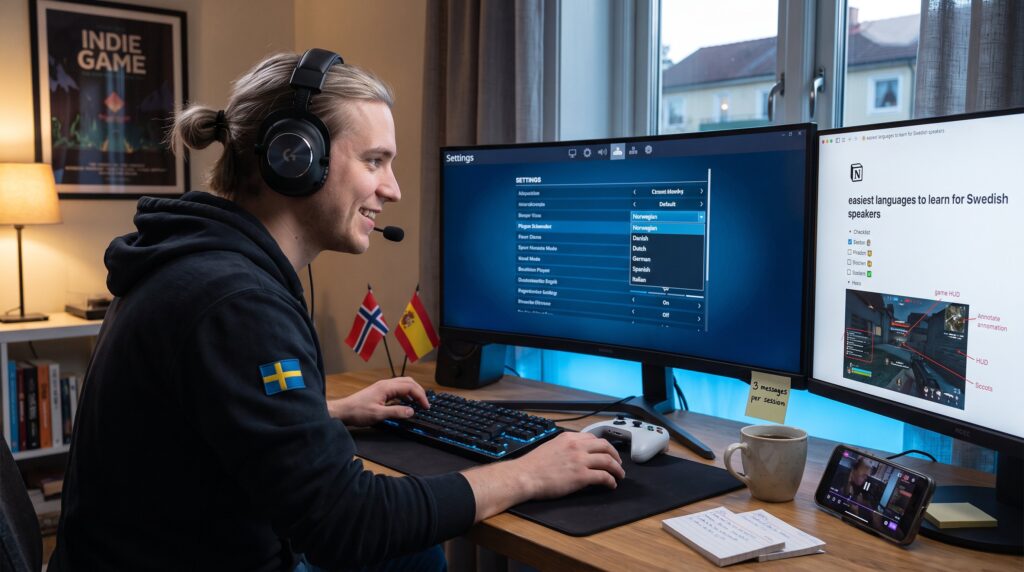
- Switching your game’s language settings and engaging in target-language chats can effectively accelerate language learning while gaming.
- Swedish speakers have a strong advantage with German, Dutch, Spanish, and Italian because of shared roots or phonetic spelling, each offering unique learning benefits.
- Using small, consistent goals like learning five new in-game terms per session helps make language learning manageable and fun.
- Practicing listening with captions and imitating streamers boosts comprehension, especially for languages with challenging pronunciation like Danish.
- Embrace mistakes as learning opportunities and avoid switching languages during competitive matches to maintain effective communication.
Why Swedish Speakers Have An Advantage Learning Certain Languages
Fact: Swedish speakers gain measurable head starts when learning related European languages because of shared roots, alphabet, and sentence structure. Swedish belongs to the Germanic family. Languages such as Norwegian, Danish, Dutch, German, and English share many cognates with Swedish. This yields instant vocabulary recognition, words like “hus” (house), “spel” (game), and “spelare” (player) look familiar across languages.
How big is the advantage? In reading, a Swedish speaker can often understand 60–80% of basic Norwegian text after minimal exposure. In listening, comprehension drops, Danish pronunciation is an exception where written similarity hides harder spoken forms. Using the same Latin alphabet removes the overhead of learning a new script. That means more time learning meaning and use, not letters.
Practical language-transfer details relevant to gamers: Swedish and many target languages share SVO word order for simple sentences. This helps when parsing chat, item descriptions, and quest text. Cognates speed up UI translation: players will often recognize weapon names, actions, and roles at a glance. But, false friends exist: a familiar-looking word can have a different meaning and cause embarrassing in-game mistakes. Expect those slips and treat them as fast lessons rather than failures.
The Easiest Language Picks (Overview And What Makes Them Simple)
Fact: Norwegian, Danish, Dutch, German, Spanish, and Italian are the fastest wins for Swedish speakers, each for distinct reasons. This section lists each language, why it’s easy, and what to watch for in gaming contexts.
Norwegian, Very close to Swedish in spelling and core vocabulary. Gamers will find UI text, patch notes, and item names nearly identical. Pronunciation differs slightly by dialect, but reading comprehension is fast. Tip: read Norwegian patch notes for your favorite game to learn common verbs and nouns.
Danish, Grammar and vocabulary align closely with Swedish, but spoken Danish compresses vowels and reduces consonants. That makes live voice chat harder to follow. Use text chat first, then move to voice when ready. Danish is great for reading guides and forum threads.
Dutch, Dutch sits between German and English, sharing many roots with Swedish through Proto-Germanic. It’s excellent for players who already know English. Sentence structures are familiar: verb placement can surprise learners. Practice by reading gaming headlines and patch summaries on Dutch sites.
German, German has many cognates and compound words that feel logical to Swedish speakers. The main hurdle is noun cases and article gender. Short drills targeting articles and case patterns remove confusion quickly. In-game inventories and skill descriptions reward even modest German skill, compound nouns like “spielzeit” (playtime) are transparent.
Spanish & Italian, These Romance languages are not Germanic, but their phonetic spellings and regular verb patterns make early progress satisfying. Spanish is particularly practical: memorizing the top 1,000 words yields quick comprehension for many gaming phrases. Use in-game language settings and aim for short spoken replies in co-op play.
Quick Comparison: Vocabulary, Grammar, And Learning Tips For Each Language
Fact: Each candidate language offers different trade-offs: fast reading vs. easy speaking vs. grammar hurdles. The table below summarizes those trade-offs and gives direct gamer-focused tips.
Norwegian, Vocabulary vs Swedish: Very similar. Grammar difficulty: Easy–moderate. Key tips: Skim Norwegian patch notes and enable Norwegian subtitles in story games. Spend 15 minutes daily matching words to actions.
Danish, Vocabulary vs Swedish: Very similar. Grammar difficulty: Moderate (listening). Key tips: Train ears with short Twitch clips and captions: copy chat phrases into notes and rehearse aloud.
Dutch, Vocabulary vs Swedish: Some overlap: close to English. Grammar difficulty: Moderate. Key tips: Read Dutch gaming headlines: learn core verbs and sentence order to avoid mis-parsing chat.
German, Vocabulary vs Swedish: Many cognates. Grammar difficulty: Harder (cases, genders). Key tips: Learn the top 100 gendered nouns used in games (weapon, armor, quest, map). Use flashcards that pair the noun with a screenshot from your game.
Spanish/Italian, Vocabulary vs Swedish: Less overlap, but phonetic spelling helps. Grammar difficulty: Easy–moderate. Key tips: Switch in-game audio to Spanish or Italian and keep subtitles in Swedish at first. Practice five short spoken sentences per match (e.g., “Jag tar flaggan” → Spanish equivalent).
Concrete practice routines that produced results for other Swedish gamers: 1) Set one game to the target language and play 3 matches daily (20–40 minutes). 2) Keep a single Notion page with 50 recurring in-game terms and update it after each session. 3) Join one language-specific server and send exactly three messages per session for the first two weeks. Those micro-habits move comprehension from 0 to functional in about 2–6 weeks depending on the language.
Practical Tips For Gamers: Learn While You Play, Stream, And Chat
Fact: Gamers can learn a new language faster by integrating it into their play loop: menus, VO, chat, and streams become study tools. These tactics fit daily gaming habits and create low-friction repetition.
Switch the game language. Change menus, HUD, and subtitles to the target language while playing a familiar mission. This links words to actions instantly, when a talent icon says “ladda” or “ladda om,” the player feels the reload. Start with familiar games to avoid cognitive overload.
Use micro-goals tied to matches. Example goals: learn five new in-game terms per session, type three full sentences in text chat, or say two voice lines out loud. Small, repeatable targets accumulate quickly, 5 terms × 20 sessions = 100 words learned.
Join language-specific guilds and servers. Look for beginner-friendly tags (“svenska vänlig” or “noobs welcome”) and set a rule: respond to every teammate with one phrase in the target language. This yields real feedback and forces retrieval under mild stress, a potent memory booster.
Watch and copy streamers. Follow 1–2 streamers who use the target language. Note commands and slang they repeat. Pause clips and write down short phrases. Over time the brain learns common calls like “push mid” or “healer ner” in the new language.
Practice deliberate listening. Start with captions on, then turn them off for short bursts. Danish needs more caption-first work because spoken forms hide familiar words. Use recorded VODs to replay confusing lines.
Vulnerable moment: one Swedish player reported sending “tack” (thanks) in German chat and accidentally typing a false friend that meant something rude. The player saved the moment by laughing it off and asking what the right phrase was. Honest mistakes like this are powerful teachers, most players are forgiving and often help correct you.
Practical warnings: avoid switching languages mid-competitive match if communication matters. Reserve language experiments for casual, co-op, or practice sessions. Also, be careful with auto-translation tools in heated moments: machine errors can escalate conflicts.
Conclusion
Insight: The easiest languages to learn for Swedish speakers are those that reduce friction, shared words, the same alphabet, and predictable sentence structure. Norwegian and Danish offer the fastest transfer, Dutch and German reward cross-linguistic logic, and Spanish or Italian give quick spoken gains. For gamers, the shortest path is to fold language practice into habitual play: change in-game language, join target-language servers, and set tiny, repeatable goals. Over weeks, small actions compound into usable comprehension and more immersive gaming experiences.