
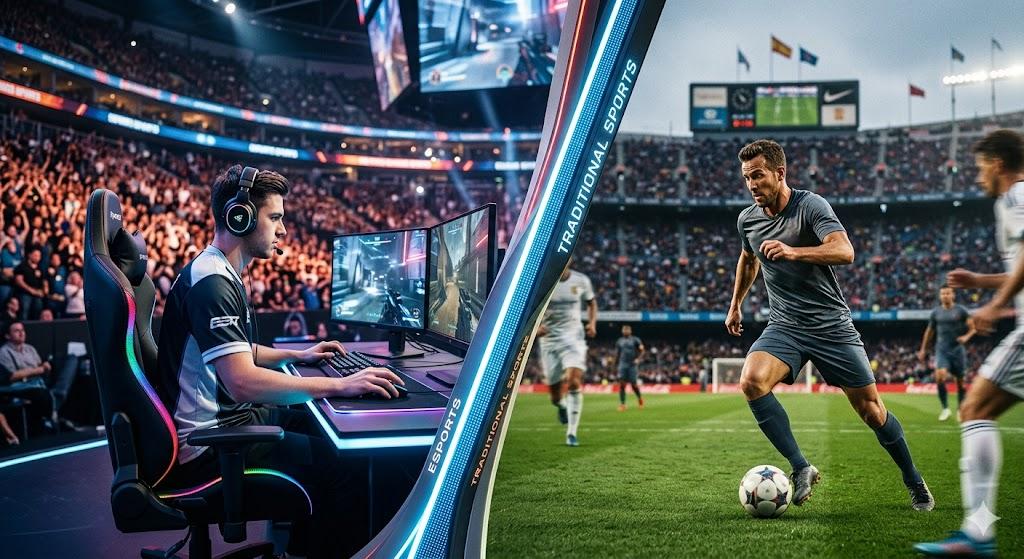
The debate over whether esports should be classified alongside traditional sports is one of the most polarizing topics in modern entertainment. As competitive gaming fills massive arenas, signs multi-million-dollar broadcast deals, and draws audiences that rival the Super Bowl, the line between “gaming” and “athletics” has blurred significantly.
But does sitting in an ergonomic chair manipulating a mouse and keyboard truly qualify as a sport? Let’s look at both sides of the coin.
The Argument For: Physicality, Training, and Structure
To the casual observer, competitive gaming looks passive. However, if you look closer at what it takes to compete at the highest level, the similarities to traditional sports are undeniable.
- Extreme Reflexes and APM: Professional esports players in games like StarCraft II or League of Legends average over 300 to 400 Actions Per Minute (APM). This requires incredible fine motor skills, hand-eye coordination, and split-second cognitive processing.
- Rigorous Training Regimens: Just like Olympic athletes, esports pros undergo intense daily training. They spend 8 to 12 hours a day reviewing strategies, analyzing opponents, and practicing mechanics, often supported by dedicated coaches, physical therapists, and sports psychologists.
- Institutional Recognition: The sporting world is already embracing digital competition. The International Olympic Committee (IOC) has officially created the Olympic Esports Games, acknowledging that competitive gaming shares the same spirit of structured, rule-bound global competition as traditional events.
The Argument Against: The Lack of Gross Motor Demand
The primary pushback from traditionalists rests on the definition of physical exertion.
Most traditional sports—like football, swimming, or track and field—require gross motor skills, physical stamina, and athletic endurance. Critics argue that while esports require intense mental stamina and lightning-fast reflexes, they lack the raw physical output that has historically defined sports.
Furthermore, video games are commercial products owned by private corporations. If a company decides to shut down a game’s servers, the “sport” ceases to exist. No single entity owns the rules of soccer or basketball, which ensures their long-term cultural stability.
Skill, Risk Management, and Alternative Proving Grounds
Regardless of which side you land on, one thing is certain: esports require an immense commitment of time. Becoming a competitive gamer means dedicating months or even years to grinding the same maps, mastering patches, and dealing with intense team dynamics.
Because of this intense barrier to entry, the gaming community has seen a massive structural shift. While the hardcore path of professional esports demands endless hours of mechanical grind, a large segment of analytical players prefers to test their strategic minds elsewhere. Many enthusiasts now choose to apply their mental sharpness, split-second decision-making, and emotional composure on modern interactive platforms like Corgibet Casino. On these premium digital stages, strict risk management, calculated probabilities, and psychological control take center stage over the physical grind, offering an immediate environment to prove one’s tactical cool.
The Verdict: A New Category for a New Era
Ultimately, trying to fit esports into the rigid, 20th-century definition of “sports” might be missing the point entirely.
Esports may not require you to run a five-minute mile, but they demand a level of cognitive endurance, strategic depth, and global competitive structure that mirrors any elite athletic discipline. Whether we call it a sport or give it a brand-new definition, competitive gaming has earned its place on the world’s biggest stages.