
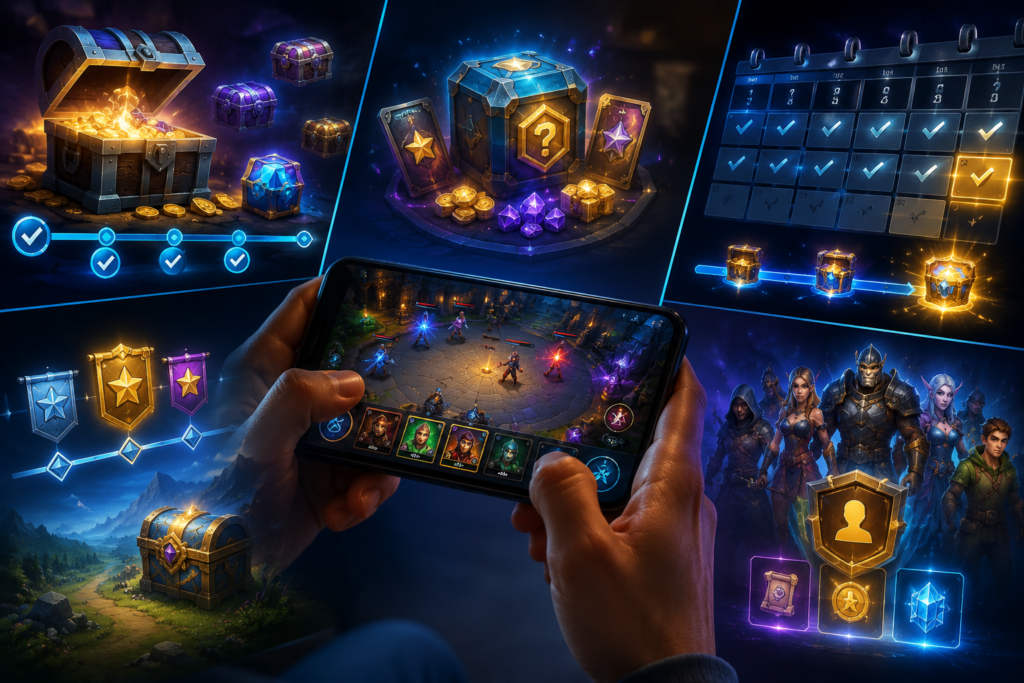
Ever wonder why so many casual phone games feel almost impossible to put down?
You open a quick puzzle app while waiting for your morning coffee. You tell yourself you will only play for two minutes. Then, before you know it, you are checking back in at lunch, logging on after dinner, and protecting a 30-day play streak like it is a prized possession.
This is no coincidence. The free games of today do not depend on high prices at the outset or strong sales pitches to maintain interest. Rather, the developers craft clever systems into the heart of their games, making playing every day a delightfully easy task and effortlessly fun.
Understanding how these design systems work explains why casual gaming has exploded in popularity across mobile phones and web browsers alike. Here are five of the most effective free-to-play mechanics that keep millions of casual gamers coming back daily.
Escalating Daily Login Rewards
Often, the simplest mechanic can be the most effective. Nearly every single casual game out there that has succeeded shows a pop-up with a reward when the player opens the app each morning.
Most times, the prize is something small on the first day; for example, maybe some additional coins or a temporary power-up. However, when you log in the next day, it gets better, and after seven days, the payout is quite large.
Psychologically, this taps into two different habits:
- Positive Reinforcement: You get immediate digital goodies just for tapping an icon on your screen.
- Loss Aversion: Nobody wants to break an active weekly streak and watch their progress reset to Day 1.
With the increasing rewards associated with consecutive days, developers make logging in a natural process for the players. The process takes just a few seconds, but once the player gets inside the building, they stay back and play a round of the game.
Low-Friction Energy and Coin Refresh Loops
Nothing is more irritating than a slow download, long loading times, or complex instructions in a game that one wants to play for only a short while. Casual games succeed because they excel at making it as easy as possible to jump into a round.
For games to maintain an audience without overtaxing them, there need to be soft constraints, like the energy meter, daily wheels, and replenishing your currency. When one begins playing the game, there will be sufficient currency for several short rounds. However, once the energy is depleted, the game will ask you to return in a couple of hours, or the next day, for a fresh supply.
This creates a comfortable rhythm. Instead of demanding four straight hours of your attention, the game fits neatly into tiny breaks throughout your day.
This exact low-friction design is what drives the popularity of modern web-based hubs. For instance, if you visit a social casino site in the US like Jackpota, you will notice that the whole experience centers on easy access and daily coin top-ups. Players do not have to download heavy desktop software or buy entry tickets just to enjoy popular slot-style titles and table games. Free virtual coins are added to their accounts regularly, giving them a stress-free reason to drop in, spin a few reels, and catch up with community leaderboards whenever they have a spare moment.
Micro-Progression and Bite-Sized Quests
A game that gives you an enormous list of objectives to complete will make you feel like doing your homework. Casual players jump into games to relax, not to manage a complex project.
That is why modern titles break long-term progression down into micro-quests. Instead of asking you to “reach level 100,” the daily task list asks you to:
- Clear 3 match-three lines.
- Collect 50 blue gems.
- Play 2 rounds with a friend.
These tasks are designed so that almost anyone can complete at least one of them within three to five minutes.
Each time you check off a task, it is a form of visible progress and is rewarding. This creates a sense of accomplishment and encourages continued engagement. For example, you see a progress bar move, collect a tiny chest, and feel like you accomplished something meaningful even if you only had time for a single session during your commute.
Time-Limited Live Events and Seasonal Content
If a game stays exactly the same for six months, even the most dedicated fans eventually get bored. That is where LiveOps (live operations) comes into play.
Modern casual games work just like live TV stations, not products. Game developers roll out short-term events every couple of days:
- Weekend tournament leaderboards.
- Holiday-themed map skins and avatars.
- 48-hour collaborative community challenges.
Because these events carry strict expiration timers (“Ends in 14 hours!”), they create a natural sense of urgency. Players log in because they do not want to miss out on an event-exclusive item or drop down the global leaderboard. It keeps the game world feeling fresh, active, and constantly moving forward.
Subtle Social Ties and Friendly Competition
Even if you like to play alone, casual games are hardly ever lonely. The game designers are well aware of the fact that social interaction is one of the most powerful methods of retaining a person’s attention.
You do not need complex voice-chat lobbies or hardcore team raids to build a community feeling. Casual games use lightweight social features that fit low-stress playstyles:
- Sending daily “free energy” gifts to friends with a single tap.
- Bragging rights on friends-only leaderboards.
- Group guilds where casual contributions help everyone unlock a shared weekly reward box.
When the game plays an important role in helping your group or maintaining the score better than that of your friend, it transforms into a low-pressure way of connecting with others.
The Secret Ingredient: Respecting the Player’s Time
At the end of the day, the free-to-play mechanics that truly work are the ones that respect the player’s busy schedule.
The best casual games do not demand hours of grinding or force complicated mechanics on you right out of the gate. They offer instant access, clear rewards for stopping by, and short, satisfying gameplay loops that fit comfortably into everyday life.
Whether it is claiming a daily login prize, clearing three quick quest items, or checking out a new weekend event, these mechanics give players a pleasant, low-stress reason to open the app day after day.