
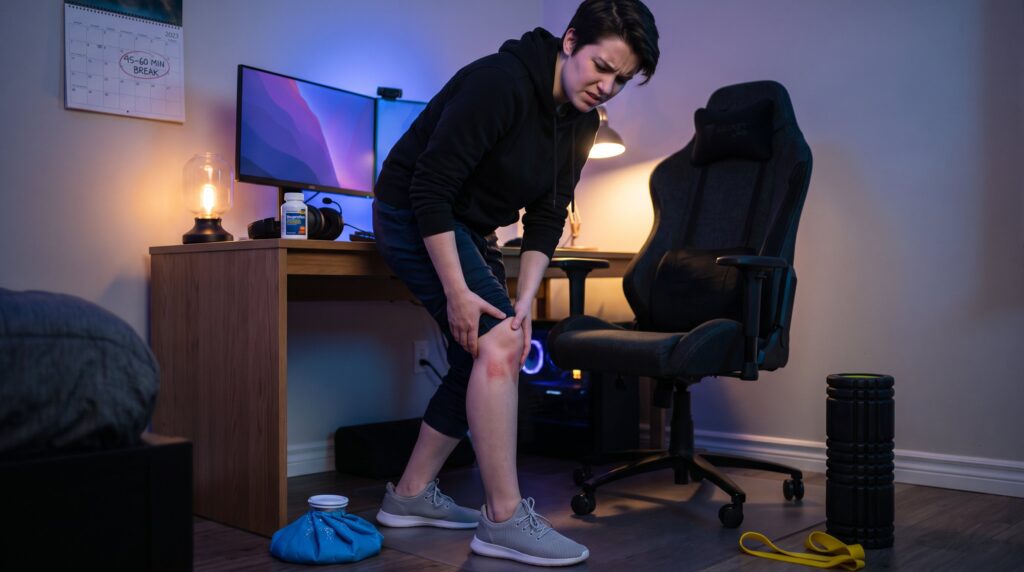
Smärta utsida knä vid böjning is a concise way to describe pain on the outer knee when bending, a problem that often hits gamers and sedentary players after long sessions. This guide explains why the outer knee hurts during flexion, how to check common causes at home, immediate steps for relief, and practical prevention strategies tailored to gamers. It uses clear signs, exact exercises, and simple ergonomics so readers can act fast and avoid making the injury worse.
Key Takeaways
- Pain on the outer knee when bending is often caused by iliotibial band syndrome (ITBS), especially in gamers after prolonged sitting or repetitive knee flexion.
- A quick self-check involves noting the pain’s timing, exact location, and movement triggers to distinguish ITBS from meniscus or ligament injuries.
- Immediate relief includes reducing load, applying the POLICE method (Protection, Optimal Loading, Ice, Compression, Elevation), and using cold packs after long gaming sessions.
- At-home rehabilitation should focus on IT band mobility exercises, hip and glute strengthening, and gentle knee range-of-motion practice to prevent stiffness and promote healing.
- Gamer-specific prevention includes ergonomic seating adjustments, regular breaks with knee bends and hip stretches, and consistent hip strength training to reduce lateral knee pain recurrence.
- Seek medical care promptly if pain follows trauma, causes locking or catching, or persists beyond 2–4 weeks despite proper self-care.
Common Causes Of Pain On The Outside Of The Knee When Bending
Fact first: the most common cause of outer-knee pain with bending is iliotibial band syndrome (ITBS), followed by lateral meniscus problems, lateral collateral ligament (LCL) strains, lateral compartment osteoarthritis, and general overload from repetitive flexion.
ITBS: Iliotibial band syndrome occurs when the tight fibrous band on the thigh rubs over the outer femur during knee movement. Pain typically appears at about 20–30° of knee flexion. A gamer who stands up, crouches, or does repeated squats in exercises may notice sharp, burning pain during bending. In one clear scenario, a weekend warrior who sat for 10 hours gaming then sprinted or cycled felt sudden outer-knee pain at a small bend, classic ITBS mechanics.
Lateral meniscus injury: A tear in the outer meniscus causes sharp, focal pain, catching, or locking with deep flexion or twisting. The pattern is different from ITBS: meniscal pain often follows a twist or a fall, and the person may report a specific moment when the knee “snapped.”
LCL strain: The lateral collateral ligament resists inward force. A varus force, direct hit or awkward awkward step, can strain the LCL, producing localized pain and sometimes bruising.
Lateral compartment osteoarthritis: In older players or those with chronic overload, the lateral compartment can develop wear. The pain here is more aching and load-related rather than sharp on a specific bend.
Overuse/overload: Repetitive bending (getting up and down for breaks, deep squats in exercise, cycling posture, or prolonged sitting with knees cramped) leads to cumulative stress. For context: sitting with knees fully flexed for hours increases joint pressure and may inflame lateral structures over weeks.
Practical note: when someone reports that the pain starts quickly during repeated small knee bends, think ITBS first. When pain follows a twisting injury with locking, suspect the lateral meniscus.
How To Do A Quick Self-Check: Symptoms, Patterns, And When To Seek Care
Answer up front: use a short symptom checklist, timing, location, quality, triggers, to separate likely ITBS from meniscus, ligament, or serious problems.
Step 1, Time and trigger: Note when pain begins. ITBS pain often builds during repetitive bending or after sustained activity and eases with rest. If the pain started with a single twist, fall, or direct blow, suspect meniscus or LCL injury.
Step 2, Exact spot: Palpate the outer knee. A narrow, burning line along the outside of the thigh down to the knee suggests ITBS. A sharp point on the joint line (a fingertip-sized spot) suggests meniscal or ligament involvement.
Step 3, Movement test (gentle): Have the person do slow knee bends while standing and note whether pain appears at a specific angle (around 20–30° often indicates ITBS). If bending causes locking, catching, or inability to fully straighten, that is a red flag for meniscus.
Red-flag signs requiring prompt medical care:
- Immediate swelling or a feeling of the knee giving way after trauma.
- Locking or catching that limits bend or extension.
- Marked redness, warmth, fever, or progressive severe pain.
- Pain that worsens even though rest and basic self-care over two to four weeks.
Real example: a player reported sharp outer-knee pain when standing from a low chair after a long session. Pain appeared at a small bend and eased with rest, consistent with ITBS from prolonged sitting and then abrupt movement.
What to document before seeing a clinician: when pain started, exact location with a fingertip, which moves trigger it, what makes it better/worse, and any swelling or mechanical symptoms. This speeds diagnosis and reduces unnecessary tests.
Immediate Relief, At-Home Treatments, And Long-Term Prevention For Gamers
Primary insight: immediate load reduction and targeted habits deliver the fastest relief, while consistent strengthening and better ergonomics prevent recurrence.
Immediate steps (first 48–72 hours):
- Protect and reduce load. Pause painful activities and avoid deep squats or lunges.
- Use the POLICE approach: Protection, Optimal Loading (gentle movement within pain-free range), Ice 10–15 minutes, Compression if swollen, Elevation when possible.
- Cold packs reduce pain and swelling quickly after activity. For example, a 15-minute cold pack after a long gaming streak decreases perceived pain enough for a short return to play.
- Over-the-counter NSAIDs (ibuprofen) help short-term if no contraindications exist.
At-home mobility and exercises (start when pain is tolerable):
- IT band mobility: Standing cross-leg stretch and gentle foam-rolls along the outer thigh for 60–90 seconds per side. Avoid aggressive rolling into sharp pain.
- Hip and glute strengthening (2–3× weekly): Side-lying hip abductions, single-leg balance holds for 10–20 seconds, and band walks for 2–3 sets of 10–15 steps. These exercises reduce lateral pull and improve knee tracking.
- Range-of-motion practice: Controlled knee bends in a pain-free arc, 2 sets of 10, three times daily, prevent stiffness without overloading.
Gamer-specific prevention (practical, measurable):
- Ergonomics: Set chair so hips are slightly above knees, feet flat. A lumbar pillow and a slightly reclined posture reduce hip and knee compression.
- Break schedule: Enforce a five-minute break every 45–60 minutes. During breaks, stand and do 10 gentle knee bends and a 30-second hip stretch. This reduces continuous flexion and clears tendon friction.
- Training plan: Two weekly 20–30 minute sessions that include hip strength and single-leg balance. Over six weeks, measurable improvements appear: reduced pain episodes and more stable knee tracking.
Warnings and lessons: many gamers try aggressive foam-rolling or deep stretching immediately: that can irritate a reactive IT band or a meniscal tear. If exercises produce sharp joint-line pain or locking, stop and seek evaluation. If symptoms persist beyond 2–4 weeks even though consistent home care, a physiotherapist or physician should assess for meniscal injury, LCL strain, or osteoarthritis.
Conclusion
Key takeaway: smärta utsida knä vid böjning most often points to ITBS or overload of the lateral knee structures, but meniscal tears and ligament injuries can mimic that pain. Gamers get the best results by reducing load immediately, following POLICE, doing targeted hip/glute strengthening, and fixing sitting ergonomics with regular movement breaks. If pain follows trauma, causes locking, or fails to improve after a few weeks of guided care, seek a physiotherapist or physician for imaging and a tailored rehab plan.